
AI money loses in Manhattan House primary
Micah Lasher won a New York congressional primary after rival AI-linked PACs spent $27 million around opponent Alex Bores.
By Daniel Okafor · Business Editor
3 min read
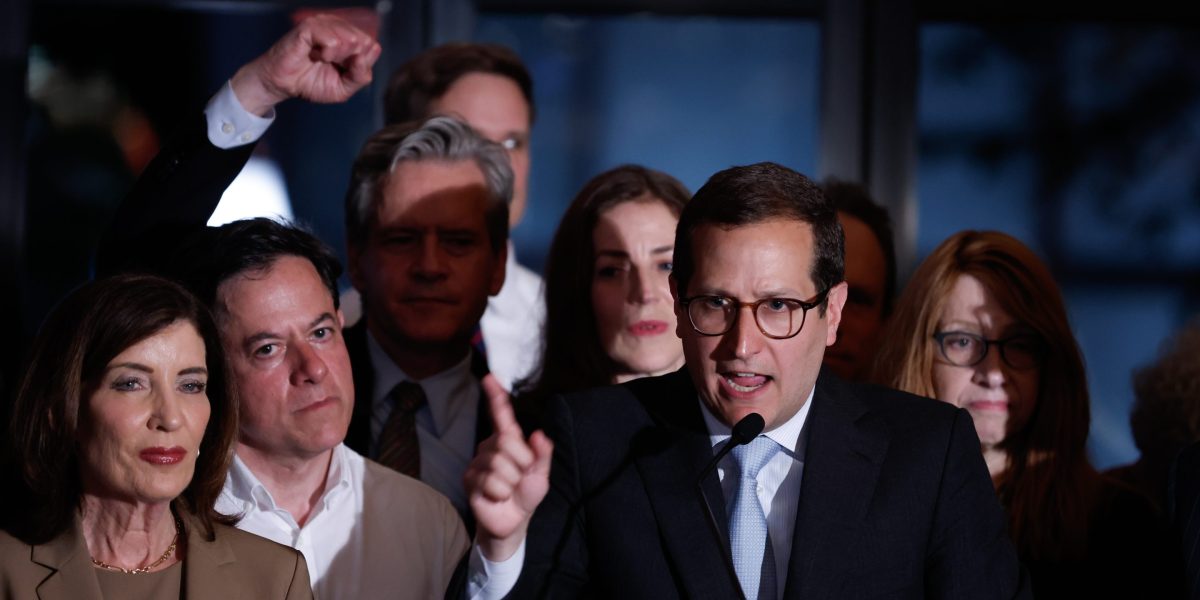
Micah Lasher won a Manhattan Democratic congressional primary after AI-linked political groups spent $27 million trying to shape the race around one of his opponents, according to Fortune. The result matters because it exposed the limits of early AI-industry spending in elections, even in a contest where regulation of the technology became a proxy fight.
Lasher, a New York state lawmaker, defeated state Assemblyman Alex Bores in the NY-12 primary with 39% of the vote, Fortune reported. Jack Schlossberg, a member of the Kennedy family, finished a distant third.
Bores became the focus of spending by rival AI factions. Fortune reported that pro-safety AI super PACs, including Anthropic-backed Public First Action, spent $19 million supporting him, while Leading the Future, a group tied to OpenAI president Greg Brockman and Andreessen Horowitz, spent $8 million opposing him.
Lasher told supporters on election night that he would not take direction from the AI companies that had focused on the race when dealing with issues involving children, jobs and the environment, according to Fortune. He also said he would pursue a similar AI regulation agenda to Bores, the candidate backed by the pro-safety side.
A rare head-to-head fight
Adam Kovacevich, a former Google public policy executive who founded the left-of-center tech trade group Chamber of Progress, told Fortune the New York primary stood out because both major AI political camps spent heavily in the same race. He said Public First Action had hoped to claim it helped elect a prominent supporter of AI regulation.
Kovacevich told Fortune that AI-related super PAC strategies appear aimed partly at sending warnings and incentives to other politicians. In his view, groups opposed to broad regulation want lawmakers to know they may face attacks if they press ahead without industry input, while pro-safety groups want regulation supporters to expect backing.
Transformer, a platform that tracks Federal Election Commission filings, reported that AI-related super PACs have spent more than $50 million on 2026 elections. Fortune cited Transformer’s tally showing about $22 million from “pro-innovation” groups such as Leading the Future and nearly $28 million from “pro-safety” PACs such as Public First Action.
Regulation fight began earlier
Fortune traced the political spending fight to 2024, when California state Sen. Scott Wiener introduced Senate Bill 1047, a state-level proposal for advanced AI regulation. Anthropic supported an amended version in a letter to Gov. Gavin Newsom, who later vetoed the bill over concerns that it was too broad and could restrain innovation, according to Fortune.
Anthropic later backed other California AI legislation, Fortune reported. In August 2025, Andreessen Horowitz, Brockman, Perplexity and other investors launched Leading the Future with more than $100 million in initial funding, according to Fortune.
Kovacevich told Fortune that voters still do not appear to rank AI as a leading election issue. An NBC News poll in March found 57% of voters said AI’s risks outweighed its benefits, while Blue Rose Research found AI had risen in importance but still ranked 29th among 39 issues it measured among more than 6,000 respondents.
Fortune reported that Lasher also benefited from a $10 million contribution from former New York City Mayor Michael Bloomberg. Kovacevich said the race may be hard to repeat, given how unusual it was for both AI factions to spend heavily in the same primary.
This story draws on original reporting from Fortune.